
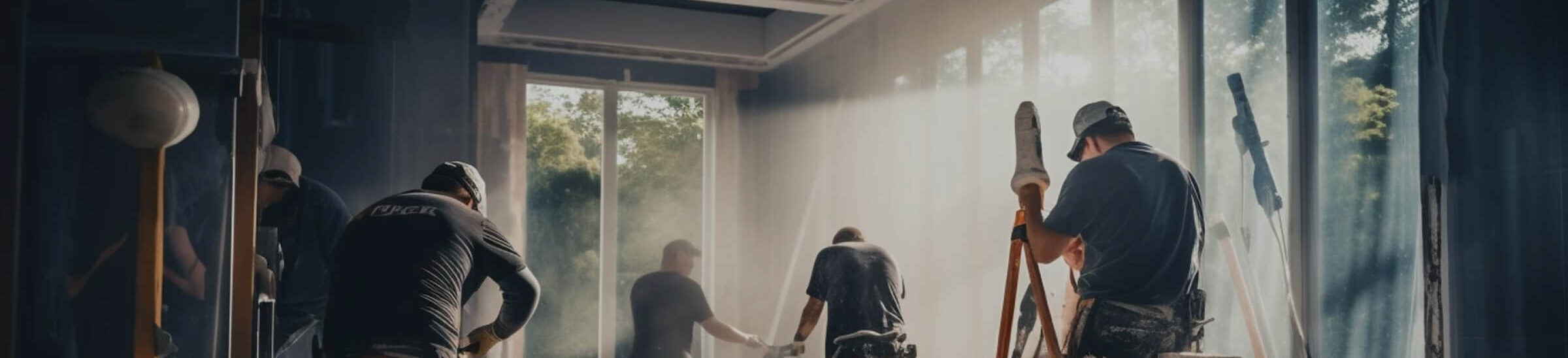
You dusted on Saturday. It’s Tuesday and the dresser has a film on it again. That’s not a cleaning failure.
The useful question isn’t how often you dust. It’s where the dust is arriving from — because most of it is arriving, not appearing.
Where it’s actually coming from:
Most people assume house dust is mainly shedding skin. The research says otherwise: roughly two-thirds of it originates outdoors, tracked in on shoes, carried on pets, blown through doors, windows and vents. About a third is generated inside.
The indoor third is mostly textiles. Carpet, upholstery, curtains, bedding and clothing shed fibers every time anything touches them, and fibers make up the bulk of what actually settles on a surface. Skin cells, pet dander and paper fibers fill in the rest.
Both halves point the same direction. Dusting removes what has already landed and does nothing about the rate of arrival, which is why the dresser is gray again by Tuesday.
So the cheapest interventions are the dullest ones: a coarse mat outside the door, an absorbent one inside, and shoes off. A vacuum with a sealed HEPA path is the next one, because it takes the reservoir out of the carpet instead of stirring it back into the room.
Your filter is probably the wrong one:
The flat fiberglass filter that costs two dollars isn’t designed to clean your air. It’s designed to stop large debris from damaging the blower. Most of what makes a house look dusty passes straight through it.
Filters are rated by MERV number. A basic fiberglass panel sits around MERV 1 to 4. Something in the MERV 8 to 11 range captures a meaningful share of household dust and pet dander for a few dollars more.
One caution: don’t jump straight to the highest number on the shelf. A very dense filter in a system that wasn’t designed for it restricts airflow, which strains the blower and can freeze the coil. MERV 11 is a sensible ceiling for most residential systems.
Check whichever one you buy monthly. Denser filters load up faster, and a clogged MERV 11 moves less air than a clean MERV 4.
And run the fan. Circulating air through a decent filter between heating and cooling cycles pulls dust out continuously instead of only when the system runs. A portable HEPA unit helps too, in the one room it happens to be standing in. It isn’t a house-wide fix.
The return duct nobody checks:
If you’ve done all that and the house is still dusty, look at the return side of your ductwork.
Supply ducts are pressurized, so leaks push conditioned air out. Returns are under suction, so any gap pulls air in — from the attic, the crawlspace, the wall cavity, wherever the duct runs. That’s unfiltered air, loaded with insulation fibers and construction dust, being drawn in and distributed through the house on every cycle.
It’s the reason some houses stay dusty no matter how diligent anyone is, and it’s invisible from the living room. It’s also what we find most often when somebody tells us they’ve tried everything.
Worth being straight about this: routine air duct cleaning is not a general cure for dust, and anyone who tells you otherwise is selling. What it’s genuinely worth doing for a specific reason — after a remodel, after water damage, if there’s visible debris in the registers, or if the system has never been touched in a fifty-year-old house. Ask what they found. Ask to see it.
Why it’s worse from November to March:
Fort Wayne winters run dry, and a furnace makes that worse. Below about thirty percent humidity, static builds on surfaces and fine dust clings rather than settling, so you see it on every dark surface in the house.
Getting winter humidity into the thirty to forty percent range changes how dusty a house looks without removing a single particle. Nobody thinks of it, and it costs less than a single service call.
You can’t stop dust from arriving. You can change what stops it at the door and what catches it in the air, and that’s a filter question far more often than a cleaning one.