Ask three cleaners what they charge and you’ll get three different units of measurement. One quotes per square foot, one per room, one a flat rate per visit — and none of those numbers compare cleanly. So here’s the honest starting point on commercial carpet cleaning cost: the price usually isn’t being hidden. The measurement is. Convert every bid to the same unit and most of the confusion disappears in about five minutes.
The second thing worth knowing is that commercial pricing has almost nothing in common with what you paid at home. A house is 900 square feet of cut-pile over padding, cleaned on a Saturday afternoon. An office is 9,000 square feet of glue-down loop with no pad, walked by sixty people a day, and it has to be dry before anyone badges in Monday morning. Different fiber, different soil load, different schedule, different math.
Here’s what actually moves the number on your quote.
Three Pricing Models, and Only One Is Auditable:
- Per square foot. The commercial default. Best above roughly 2,000 square feet, because it scales predictably and you can check the arithmetic yourself.
- Per room or per area. Better for suites carved into small offices and medical exam rooms, where usable carpet is a fraction of the gross footprint.
- Per visit or per contract. Standard for recurring work in retail, hospitality and multi-family common areas, where the same crew returns on a fixed rate.
If a bid arrives in a unit that doesn’t match your floor plan, ask for it both ways. Any legitimate contractor produces that on the spot.
The Range Is $0.15 to $0.35 — but Check Which Footage They Measured:
National cost-tracking sources put commercial carpet cleaning at roughly $0.15 to $0.35 per square foot, with low-moisture encapsulation at the bottom and hot water extraction at the top. Most companies carry a $100 to $150 minimum, which is why a small suite never costs what the per-foot math promises.
Now the part nobody mentions: find out whether you’re being quoted on gross building footage or actual carpeted area. Tile corridors, break rooms, restrooms and stairwells account for a fifth of some floor plates. On a 10,000-square-foot lease, that gap runs a few hundred dollars a visit — every visit. Get net carpeted square footage in writing.
Fort Wayne isn’t a coastal labor market, so bids here land in the lower-to-middle part of that range. Scope still moves the number more than geography.
Five Things That Push the Price Up:
- Soil level. Nine months of Indiana road salt ground into loop pile is a different job than light office dust.
- Carpet construction. Glue-down loop, broadloom over pad and carpet tile each behave differently under a wand.
- Furniture. Moving desks and file cabinets is labor, and it belongs on its own line.
- After-hours scheduling. Nights and weekends cost more, and most offices have no alternative.
- Traffic-lane treatment. Pre-spray, dwell time and agitation add crew hours.
How to Clean High Traffic Carpet Areas Without Wasting the Budget:
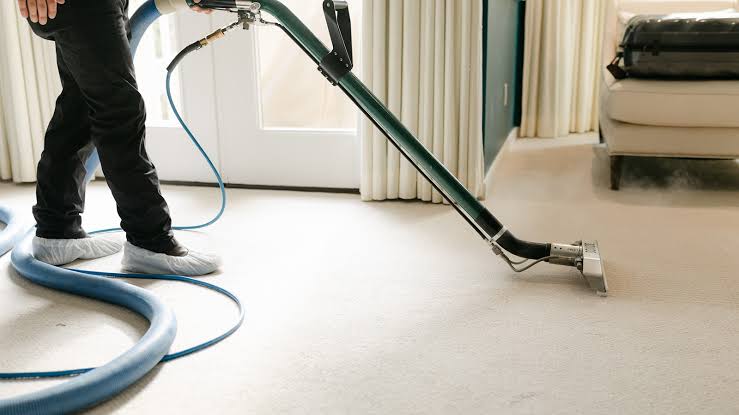
How to clean high traffic carpet areas is a different question from how to clean the rest of the floor, and answering it the same way is why your entryway looks tired six months after a full clean. Corridors, entries and elevator lobbies don’t just collect more soil — they wear. Grit under shoes abrades the fiber, and abraded fiber scatters light. That grey lane running from your front door often isn’t a stain at all. It’s damage, and no amount of extra surface cleaning lifts it.
So the best way to clean high traffic carpet is targeted, not uniform: pre-spray with real dwell time, mechanical agitation to break bonded soil loose, then extraction. The contrarian version — cleaning the whole floor twice as often with the wrong method costs more and looks worse than cleaning it half as often with the right one. Steamatic’s carpet and high traffic area cleaning works from that distinction.
Cheaper still: matting. The EPA’s guidance on indoor pollutants is blunt about it — stop dust at the door, because entrance mats cut the dirt tracked inside. Fifteen feet of proper walk-off matting costs less than one annual cleaning.
Schedule by Business Type — and by Season:
- Office: full extraction once or twice a year, traffic lanes quarterly. Most Fort Wayne office cleaning programs run on that split.
- Retail: quarterly, more near entrances.
- Medical: quarterly minimum, waiting rooms first.
- Hospitality: monthly in public areas.
- Multi-family common areas: quarterly, timed to lease turns.
Those are industry norms and manufacturer warranty expectations, not federal rules. Worth saying plainly, because cleaning companies have quoted “EPA-recommended” frequencies for years — and the EPA has stated it never issued them. Anyone selling you a schedule on that basis is working from a misattributed 1989 letter.
Timing matters as much as frequency here. Booking your big annual clean in December burns money — salt season runs into March. Schedule the deep clean for April and the results hold.
Replacement Costs Roughly Eight Times What Maintenance Does:
A 5,000-square-foot office cleaned twice a year at $0.25 a foot runs about $2,500. Replacing that carpet — material, tear-out, disposal, install — clears $20,000 comfortably, and arrives years sooner when abrasive soil sits in the pile. Need the budget-meeting version? Thirty employees in that space works out to roughly $83 per person per year. That’s the framing that gets approved.
What a Real Quote Includes, and What a Cheap One Skips:
A proper estimate names the method, the measured footage, whether furniture moving is in or out, expected dry time, and which spotting or protectant treatments are covered. Red flags: a price quoted over the phone with no walkthrough, no method stated, “three rooms for $99” pricing offered to a commercial building, and no certificate of insurance. The ANSI/IICRC S100 standard, now in its seventh edition, governs professional textile floorcovering cleaning — ask whether the crew works to it and watch how fast the answer comes.
Frequently Asked Questions:
Q1. Can our janitorial team handle it?
Vacuuming and spotting, absolutely. Extraction needs truck-mounted or commercial-grade portable equipment.
Q2. How long before we can walk on it?
Four to six hours after hot water extraction. Encapsulation is often walkable within the hour.
Q3. Does cleaning make carpet dirty faster?
Only when residue gets left behind. Proper rinse extraction doesn’t do that.
Final Thoughts:
Commercial carpet cleaning cost looks unpredictable right up until you standardize the unit and pin down the scope — then it becomes one of the more forecastable lines in a facilities budget. Ask for the method, the net footage and the frequency, and you’re comparing real numbers instead of marketing.
Local commercial cleaning Fort Wayne crews with commercial-grade equipment and after-hours availability can build the schedule around your operating hours instead of the reverse.