

The trucks pull out on day four. The fans go quiet, the dehumidifiers stop rumbling through the floor joists, and for the first time since the pipe let go, you can hear your own house again.
It’s also still torn open. Bottom two feet of drywall gone in the family room. Baseboard stacked in the garage. A third of the flooring is missing. And nobody has said a word about who puts it back.
Almost every homeowner hits this moment, and almost none see it coming. That’s not carelessness. Water mitigation and reconstruction are two separate scopes — priced separately, often approved separately by your insurer, frequently performed by two different companies. You assumed the crew that dried the house would rebuild it. Plenty do. But unless somebody said so in writing, that assumption is doing a lot of unearned work. Knowing where one phase ends and the next starts keeps a claim from sitting dead for three weeks in the space between them.
Mitigation Is Damage Control, and That’s All:
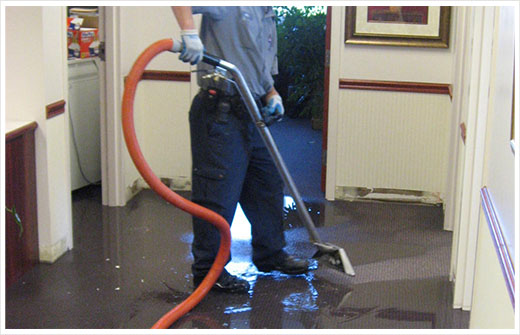
Stop the source, pull the water, dry the structure to a verified standard, remove what’s too far gone to save. That’s the entire scope. It’s emergency work, billed against the mitigation line of your claim, and the mechanics — inspection, drying, daily readings — are laid out in our step-by-step water damage restoration process article. Worth ten minutes if you’re mid-claim right now. Emergency water removal and structural drying live entirely inside this phase.
What matters here is what mitigation isn’t. No drywall. No flooring, trim, cabinets or paint. Different scope, different money, different crew.
“Dry Standard Reached” Closes a Contract, Not a Project:
It means affected materials have been metered back to the baseline set on day one, verified and documented. Sign it and the mitigation scope closes. Right then your house is dry, sound, and visibly unfinished. Equipment leaves. The mitigation invoice finalizes. And here’s what catches people flat — nothing else gets scheduled unless you schedule it. Your adjuster isn’t waiting to spring into action. The rebuild clock starts when someone requests an estimate, and that someone is usually you.
The ANSI/IICRC S500 standard governing professional drying says outright that it covers mitigation, not the repairs that follow. Not a gap in the standard. Genuinely different trades.
Home Restoration Is the Bigger Half of the Job:
Home restoration is the rebuild: insulation, drywall, tape and texture, flooring, trim, cabinetry, doors, paint. Target is pre-loss condition — the room as it was, not the room you’ve been meaning to have. Mitigation on a typical residential loss runs a few thousand dollars. Reconstruction routinely clears five figures, because it’s materials plus skilled labor plus permitting wherever structure or electrical is involved. Which is why the two get approved separately. Mitigation is authorized fast under emergency provisions, since waiting compounds the damage. Reconstruction goes through a written estimate your adjuster reads line by line.
Two Money Details Worth Knowing Before the Estimate Lands:
Your deductible applies to the claim as a whole, not to each scope — so it typically comes out of the earliest payment, and the rebuild figure reaches you accordingly. Check your declarations page rather than assuming. The second one costs people real money. Under replacement cost coverage, insurers commonly pay the depreciated amount first and release the withheld balance only after repairs are finished and documented. That holdback is recoverable — but most policies set a deadline, often one to two years, and miss it and the money is gone. Actual cash value policies have no second payment at all.
Three questions close the gap:
- Is reconstruction in my scope, or was this mitigation only?
- Who writes the rebuild estimate, and when does it reach the adjuster?
- What’s the rebuild start date — not the drying end date?
The Handoff Is Where Documentation Gets Thin:
Two good companies can handle this. But a rebuild crew inherits a house they never saw wet, working from another company’s photos and notes. One team carries the moisture logs, the pre-demolition photos and the scope forward without translating anything. When a question surfaces in week three about what was behind that wall, somebody on the job remembers.
Water damage repair Fort Wayne homeowners get from a single continuous team also means one point of accountability instead of two contractors pointing at each other across the living room.
Fort Wayne Housing Stock Complicates the Rebuild, Not the Drying:
Finished basements in the newer subdivisions mean framing, drywall and flooring below grade — all of which must read dry before anything closes up. The older near-downtown neighborhoods bring plaster and lath, which behaves nothing like drywall and wants a plasterer, not a drywall crew. Hardwood deserves assessment, not assumption. Cupped flooring often flattens on its own as it releases moisture, and a crew that condemns it on day two may tear out a floor that would have come back. That judgment separates real water restoration Fort Wayne work from a fast tear-out, and it’s worth pushing back on.
Then there’s matching. Discontinued flooring and out-of-production cabinet lines plague homes fifteen years and older, and policies differ on whether they’ll pay to extend replacement into undamaged rooms for a continuous look. Ask early. Finding out after approval is how people end up with two floors meeting at a doorway.
Realistic Sequencing, Start to Finish:
Rebuild can’t start until readings confirm dry. Closing a wall over damp framing buries a mold problem inside finished construction — considerably worse than the original loss. From sign-off: a few days to a week for the estimate and adjuster approval, then one to three weeks of rebuild on a contained residential loss. Longer with cabinetry or custom millwork, since those get ordered, not pulled off a shelf.
Frequently Asked Questions:
Q1. Will my mitigation company automatically rebuild?
Only if it’s in your signed scope. Ask directly — don’t assume.
Q2. Is it one claim or two?
Usually one claim, two scopes, approved at different times.
Q3. Can I use my own contractor for the rebuild?
Generally yes. Your insurer can recommend; the choice is normally yours.
Final Thoughts:
The gap between drying and rebuilding is where water damage Fort Wayne claims lose momentum — not because anything went wrong, but because nobody named the handover out loud. Ask who owns the rebuild before the equipment leaves, and the second half moves as cleanly as the first.
A local team offering both home restoration services Fort Wayne IN residents rely on and full property damage restoration services Fort Wayne IN insurers recognize can carry one scope and one set of records straight through to the finished room.