
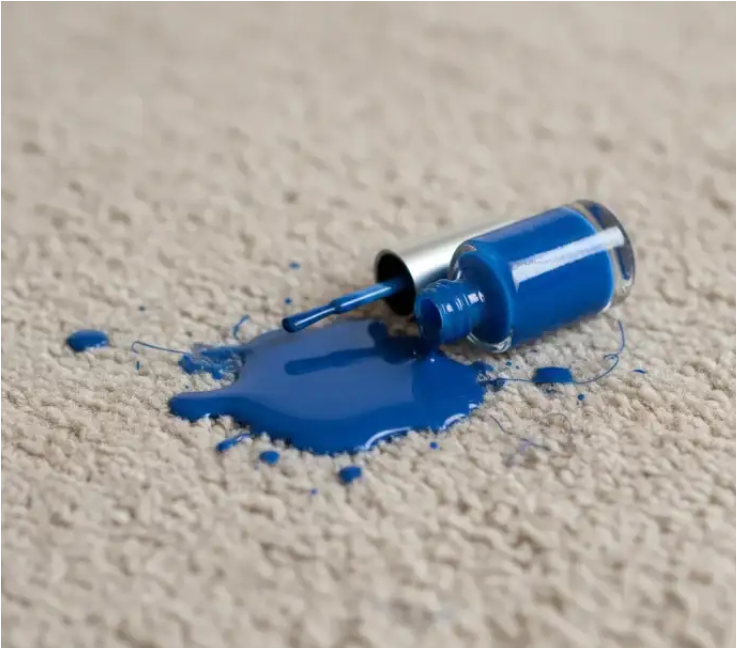
Almost every stain guide tells you to move fast. Nail polish is the exception, and moving fast is why most polish spills end up bigger than they started. Wet polish is a lacquer suspended in solvent. Touch it with a paper towel and you don’t lift it — you thin it, spread it, and press it down between the fibers where nothing can reach it. A neat little spot becomes a smear, and now it’s in the base of the pile rather than sitting on top.
So do the thing that feels wrong. Leave it alone.
Let it harden:
Give it twenty minutes. A hair dryer on cool or a bag of ice against the spot gets you there faster if you’re in a hurry. What you want is polish that’s gone from liquid to brittle.
Hardened polish sits on the fibers as a crust. That’s a mechanical problem, and those are the easy kind.
The exception is a puddle deep enough to be soaking downward while you watch. Lift what you can with the edge of a spoon, scooping upward rather than wiping sideways, then let the rest set.
Chip before you dissolve:
Most of a dried spill comes out with no chemistry at all. Work the edges with a dull knife or the corner of a credit card, cracking the crust into flakes rather than lifting it whole. A stiff brush breaks up what’s caught around individual fibers. Vacuum between passes so the flakes don’t get pressed back in.
People skip this and go straight for the remover, which is backwards. Every flake you take out dry is one you don’t need solvent for, and solvent is the part of this job that does the damage.
Then, sparingly, the solvent:
Start with non-acetone remover. It’s slower, and slow is what you want. Test on a hidden patch first, in a closet or under furniture. Wait for it to dry fully before you judge it, because solvent damage shows up as the fibers dry, not while they’re wet.
Apply it to a white cloth, never to the carpet. Press the cloth against the stain for thirty seconds to soften the residue, then blot from the outside of the mark toward the middle so you’re not pushing color outward. Switch to a clean section of cloth constantly. A colored cloth will hand you its own dye on top of the polish.
Rubbing alcohol is the sensible middle step, and it’s why the hairspray trick has a reputation — old formulas carried enough solvent to soften polish. Modern ones are mostly resins, so you’d be adding a film to the spot you’re cleaning. Use the alcohol, skip the hairspray. Whatever you use, rinse afterward: blot a little cool water through the spot and dry it. Solvent left sitting in the pile carries on working after you’ve stopped.
If none of that touches it, acetone will — but read the next section before you open the bottle. Then a few drops on the cloth, blot, reassess.
What actually gets damaged:
The fibers are usually not what fails.
Underneath the pile is a latex adhesive holding the tufts into the backing. Acetone dissolves it. Pour remover onto a spot, enough runs down to soften that bond, and months later there’s a patch where the fibers lift out in your hand. We get called for that one long after anyone connects it to a bottle going over.
Fiber type matters too. Nylon, polyester, and olefin tolerate brief acetone contact. Acetate, triacetate, and modacrylic don’t — acetone dissolves them on contact and leaves a hole, and older or specialty carpets are where you find them. On nylon there’s a quieter cost: acetone strips the factory stain-resist finish, so that patch soils faster than everything around it from then on. If the spill is bigger than a coin, if the carpet is wool, or if you don’t know what the fiber is, stop guessing. Professional carpet cleaning costs less than a patch repair, and a great deal less than a bald spot you find in the spring.
Polish is a small problem. The bottle of remover in your other hand is the large one.