
Slime comes out of the carpet more easily than most parents expect. The dye in it doesn’t, and that’s the part nobody warns you about.
Homemade and store-bought slime are both mostly white school glue crosslinked with a borax or saline activator, plus food coloring and, if you’re unlucky, glitter. That’s two different problems sitting in the same spot. The rubbery mass is mechanical and comes out with cold and patience. The color is a dye stain, and it plays by entirely different rules.
Fresh slime: cold, never wet:
The instinct is to grab a damp cloth. Don’t. Water makes fresh slime slick and pushes it deeper into the pile, turning a two-inch blob into a six-inch smear.
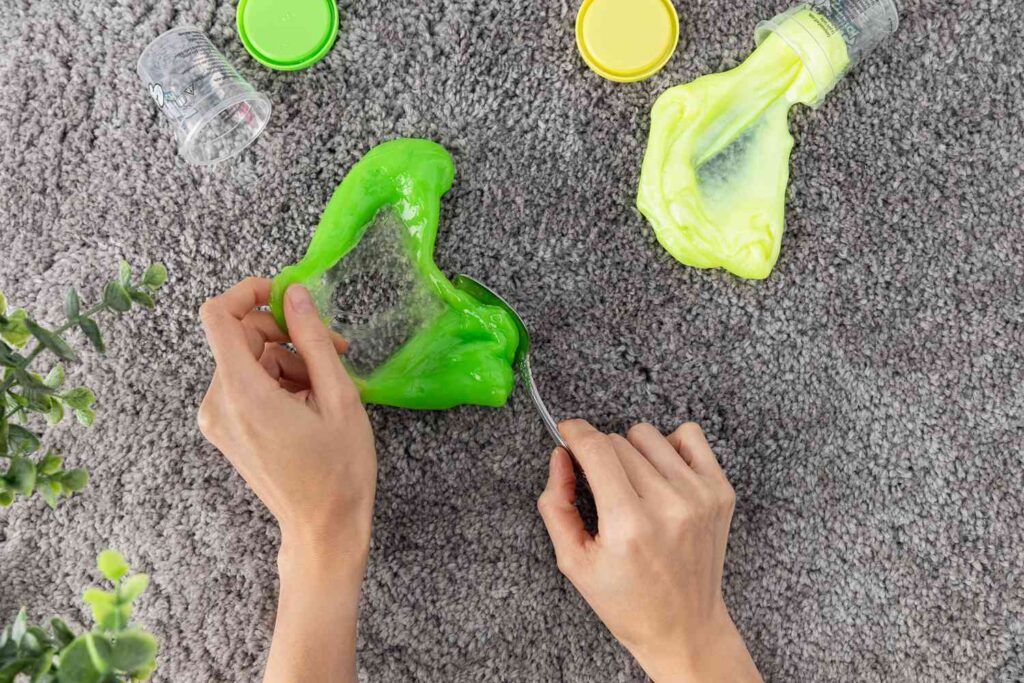
Scoop first. A spoon or a dull butter knife, lifting straight up rather than dragging sideways.
Then chill whatever’s left. Ice cubes in a sandwich bag, held against the spot for ten or fifteen minutes, until the slime goes hard and dull. Cold slime cracks. Warm slime stretches. Once it’s brittle, work it free with the edge of the spoon and vacuum the fragments before they warm back up.
Dried slime: you’re already halfway done:
Dried is the easier case, which surprises people who’ve spent a week avoiding it.
It’s already brittle, so break it up with your fingers, scrape with a spoon, and vacuum. Only then bring in liquid: white vinegar and warm water in equal parts, sprayed lightly, left five minutes to soften what’s still gripping the fibers.
Vinegar earns its place here for a reason: the borax crosslinks holding slime together come apart in acid, which is why it dismantles this particular mess and does nothing for most others.
Blot, don’t scrub. Scrubbing frays the fiber tips and leaves a dull patch that will outlast the stain by years.
The color is a second stain:
Get the goo out and you’ll often be looking at clean carpet with a blue island in it. That’s a separate job.
Start with a teaspoon of clear dish soap in a cup of cold water, applied with a white cloth — a colored cloth can transfer dye of its own. Blot from the outside of the mark inward, moving to a clean section each time. If color remains, a tablespoon of household ammonia in a cup of cold water is the step that actually works on artificial food dye. Three percent hydrogen peroxide, cut with equal water, is the last resort. Rinse between each and expect several passes.
Two things make that tint permanent. Heat is the first, and it’s the one we get called about: hot water sets dye, so a steam cleaner or a rented extractor run over an untreated stain finishes the job for you. Time is the second — dye keeps binding to the fiber the longer it sits.
Glitter is the third thing in that jar and none of the above touches it. It’s plastic film, so it only comes out mechanically: vacuum in several directions, then lift the stragglers with the sticky side of packing tape. Anything wet just glues it further down.
Wool and wool blends are their own category. Skip every one of these — no vinegar, no ammonia, no peroxide. Blot with cool water and call a rug cleaner.
Knowing when to stop:
If you’ve done four or five passes and the color has stopped lifting, stop. More scrubbing damages fiber without touching dye, and a worn patch is more noticeable across a room than a faint tint.
That’s also the honest threshold for calling someone. Professional carpet cleaning extracts from the base of the pile and the backing rather than the surface, which is where the last of a dye stain hides. It also costs less than replacing a section of carpet you sanded flat trying to win.
Worth knowing before the next batch: slime on a hard floor is a five-minute problem, and slime on carpet is an hour. A cheap plastic tablecloth, spread out before the jar comes open, prevents all of it.
The goo is a ten-minute job. The color is the part that decides how that patch of carpet looks a year from now.